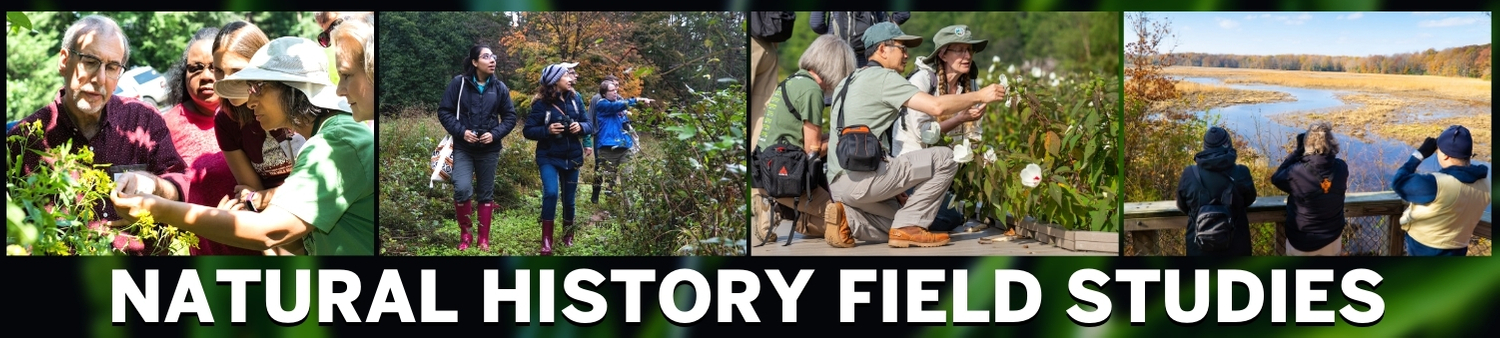
This unique continuing education program for adults provides a comprehensive and stimulating view of our region’s natural history and conservation issues. Taught at the college freshman level, these courses are open to anyone 18 years of age or older, professionals and amateurs alike. A Certificate of Accomplishment in Natural History is awarded to those choosing to complete a required curriculum of 39 Continuing Education Units (CEUs), but anyone can enroll in any class for the sheer pleasure of learning.
SPRING 2021 COURSES: March 17 - June 3
Registration Information for
Natural History Field Studies Classes
Registration is now being handled completely online by the Audubon Naturalist Society (not the Graduate School USA) through our adult program registration system.
- Questions? Contact pam.oves@anshome.org
- Refund Policy for NHFS classes: ANS will provide you with a refund (minus a $25 administration fee) if you cancel your enrollment no later than the day following the first class lecture. After this date, no refunds will be provided. In the event of a course cancellation due to insufficient enrollment or other events beyond our control, we will notify you as soon as possible and provide you with a full refund.
Due to the COVID 19 pandemic, NHFS classes are being offered via online Zoom sessions with some courses offering optional in-person field trips as well. Students can register for the virtual lecture sessions only, or for lectures plus field trips, assuming space is available. NOTE: The locally-based field outings will be limited to groups of 8 participants, with mask-wearing and social distancing required. Different courses may offer different field trip options, so please read the course description carefully before registering.
What students are saying about
Natural History Field Studies:
“I am incredibly grateful for the opportunity to take classes in the NHFS program. Most environmental education is aimed at children and youth. Because nature programming wasn’t a part of my suburban childhood (and I might not have cared about it or retained it in any case) I am thrilled to be able to learn about natural history as an adult – ‘when the student is ready, the teacher appears.’ Thanks to the Audubon Naturalist Society, natural history is becoming a passion.”
- R. Gray
NHFS Student
Freshwater Ecology
NATH8217E, 3 CEUs
This course will focus on stream ecosystems and the human-caused stressors that affect them. Topics include forms of freshwater; stream structure and function; benthic macroinvertebrates, freshwater fish, and their ecological interactions; stormwater management, and ecological restoration. At the end of this course, students will have an understanding of the physical, chemical, and biological processes of freshwater bodies. Self-exploration of local waterbodies will be emphasized. On field trips, students will visit stream restoration sites, examine fish and aquatic organism habitat types, and sample for benthic macroinvertebrates. Registration closes April 2.
Class Schedule: April 6 - June 1, Tuesdays, 7-9 pm
Class Location: Online via Zoom
Field Trips: April 24 (Group A AM, Group B PM) and May 15 (Group A AM, Group B PM)
Course Fees:
Zoom Lectures Only: ANS Members $240; nonmembers $265
Zoom Lectures + Field Trips: ANS Members $300; nonmembers $330
REQUIRED READING: The Biology of Streams and Rivers, by Paul S. Giller and Bjorn Malmqvist (Oxford University Press, reprinted 2011)
Pond Life, a Guide to Common Plants and Animals of North American Ponds and Lakes, by George K. Reid (A "Golden Guide" from St. Martin's Press, revised 2001)
About Your Instructor
Cathy Wiss is a team leader in the ANS Water Quality Monitoring Program at two monitoring sites on Ten Mile Creek in Montgomery County, MD. From March 2008 through August 2020, she served as the ANS Water Quality Monitoring Program Coordinator. In addition, Cathy has worked to preserve streams, trees, and a wetland in her neighborhood and to encourage developers to incorporate Low Impact Development techniques into their projects. She holds a Juris Doctor degree from Catholic University Law School, a Bachelor of Arts degree from Smith College, and a certificate in Natural History Field Studies.

Cathy Wiss
Spring Flower Identification
NATH7135E, 3 CEUs
Follow the changing of the season this spring as we look closely at wildflowers blooming in the Mid-Atlantic each week. The class will include field identification during different life stages, plant family relationships, and habitat preferences so you can get outside and hunt yourself (by recording flower observations in an optional iNaturalist class project). Explore the relationships between the plants and their pollinators and seed dispersers to gain an understanding of each flower’s role in the ecosystem. Spring wildflowers deserve our admiration for their incredible adaptations to overcome seasonal vagaries from low temperatures to short growing seasons. The field trips feature two of the area’s best wildflower locations. Students will choose a field trip group at a later date. Registration closes March 12.
Class Schedule: March 17-May 12, Wednesdays, 6-8 pm
Class Location: Online via Zoom
Field Trips: FIELD TRIP OPTION FULL
Location TBA: Group A: April 15, Group B: April 18; Thompson WMA
Group A: May 2, Group B: May 4
Course Fees:
Zoom Lectures Only: ANS Members $240; nonmembers $265
Zoom Lectures + Field Trips: ANS Members $300; nonmembers $330
RECOMMENDED TEXTBOOK: Newcomb's Wildflower Guide by Lawrence Newcomb. Publisher: Little, Brown & Company, ISBN 10: 0-316-60442-9 OR if you prefer a digital flower identification guide: The Flora of Virginia app: https://floraofvirginia.org.
Clare Walker
About Your Instructor
Clare Walker is an environmental educator at Irvine Nature Center where she manages the woodland gardens. She previously worked as an education specialist at the Maryland Department of Natural Resources developing programs and guides about pollinators and other wildlife concerns. She is currently assisting the USGS Bee Lab in creating pollinator gardens for specialist bees. Ms. Walker did her Ph.D. work studying Peatlands, at Huddersfield University.
Introduction to Ornithology
NATH7118E, 3 CEUs
Learn about birds and their special characteristics. Study their external and internal anatomy, feather structure, plumage and special adaptations for flight and feeding. We’ll study bird behavior including migration, courtship, mating, nesting, and care of the young. And we’ll explore bird habitats, ecology, conservation, and distribution worldwide. Field trips emphasize field identification, bird song and other behavior. Students will choose field trip group at a later date. Registration closes April 2.
Class Schedule: April 8 - June 3, Thursdays, 7-9 pm
Class Location: Online via Zoom
Field Trips: FIELD TRIP OPTION FULL
Hughes Hollow – Group A: April 24, Group B: April 25; Little Bennett Regional Park – Group A: May 22, Group B: May 23 (max 8 students)
Course Fees:
Zoom Lectures Only: ANS Members $240; nonmembers $265
Zoom Lectures + Field Trips: ANS Members $300; nonmembers $330
RECOMMENDED TEXTBOOK: A good field guide such as Sibley or National Geographic.
Gemma Radko
About Your Instructor
Gemma Radko is the Communications/Media Manager for the American Bird Conservancy. She completed MAPS (Monitoring Avian Productivity and Survivorship) training through the Institute for Bird Populations in1998. A licensed bird bander, she operated the MAPS station at Adventure in Potomac, MD. B.A., Allegheny College.